
Optimising Your Health Through Breathwork: A Guide for Mums

If you’ve ever found yourself breathing quickly, feeling overwhelmed, snapping at your kids, lying awake despite being exhausted, or running through your day on autopilot, you are not alone.
Modern motherhood is full of constant demands and our nervous systems are working harder than ever to keep up.
In this article, we explore how breathwork can support your physical and emotional wellbeing, based on Danielle Smith’s masterclass on breathing, stress, and health.
Breathwork is simple, free, and available to you at any moment. The key is learning how to use it in a way that helps your body and mind feel calm, steady, and supported.
Why Your Breath Matters
Most mums are living in a “go, go, go” state, rushing between children, home, work, appointments, meals, and the endless mental load.
Danielle explains that this constant stress keeps many women stuck in fight-or-flight mode, making it harder to cope, sleep, focus, or feel grounded.
Your breath is one of the few tools that can directly change how your nervous system responds.
When you learn to breathe well, you can:
- Reduce stress
- Calm racing thoughts
- Improve sleep
- Boost energy
- Help digestion
- Ease neck tension and headaches
- Support pelvic health
- Feel more emotionally regulated
And you don’t need long meditation sessions or special equipment. You only need your breath.
Understanding Your Nervous System
Your autonomic nervous system has two key branches:
- Sympathetic (Stress Response) — fight, flight, overwhelm
- Parasympathetic (Peace Response) — rest, digest, recover
A healthy nervous system can switch between the two smoothly.
But as Danielle explains, many mums become stuck with their “accelerator” pressed down, constantly switched on, without enough recovery time.
This can look like:
- Feeling constantly tense
- Feeling wired but tired
- Reacting quickly
- Trouble sleeping
- Fatigue that never fully lifts
- Digestive issues
- Feeling like you’re “always on edge”
Breathwork helps you move out of the stress response and into a calmer, more balanced state.
The Vagus Nerve: Your Body’s Calm Button
The vagus nerve is one of the most important parts of your nervous system. It helps regulate:
- Heart rate
- Digestion
- Breathing rhythm
- Emotional regulation
When the vagal tone is strong, you can calm yourself quickly.
When it’s weak, stress lingers in your body much longer. Danielle explains that many mums have weakened vagal tone simply because they are not breathing properly.
Diaphragmatic breathing, using your rib cage and belly, not only calms your system but literally massages the vagus nerve to strengthen it over time.
Why Chest Breathing Makes Stress Worse
Many women breathe high in the chest without realising it.
This type of breathing can:
- Increase anxiety
- Cause neck pain
- Lead to headaches
- Reduce oxygen delivery to cells
- Keep the nervous system stuck in stress mode
This is especially common for breastfeeding mums who spend long hours hunched forward, or mums who are constantly rushing and shallow breathing.
Learning to breathe with your diaphragm creates space, calm, and better oxygen flow.
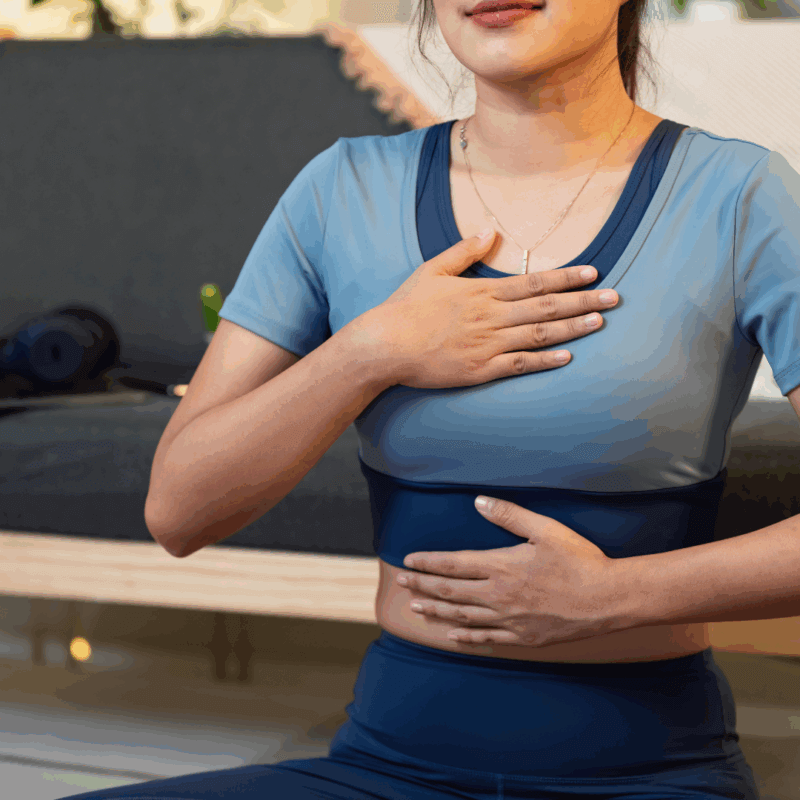
How to Breathe Using Your Diaphragm
Here’s how Danielle teaches mums to reconnect with their natural breathing pattern:
- Place your hands around your rib cage
- Inhale gently through your nose
- Feel your ribs expand outward, sideways, and back
- Exhale slowly and feel your waist narrow
- Keep your shoulders soft and relaxed
This “three-dimensional” breathing helps:
- Calm the body
- Improve digestion
- Support pelvic health
- Reduce back pain
- Strengthen the core safely
Even a few breaths can shift how your body feels.
Simple Breathwork Techniques for Everyday Stress
Danielle shares several practical breathing tools mums can use anytime, especially in moments of overwhelm.
1. Box Breathing (for moments of stress)
Used by the US military to stay calm under pressure.
Inhale 4 – Hold 4 – Exhale 4 – Hold 4
Perfect for:
- Overwhelm
- Frustration
- Feeling emotionally flooded
- Resetting before responding to your kids
2. The Physiological Sigh (for quick calm)
A powerful technique supported by neuroscience.
Two quick inhales through the nose, one long exhale through the mouth
Repeat 3–4 times.
Great for:
- Sudden stress
- Panic
- Irritation
- Quickly calming your heart rate
Danielle calls this a “hack” into the parasympathetic system.
3. Cadence Breathing (for sleep+rest)
This is the most powerful technique for bedtime or nap time relaxation:
Inhale 4 – Exhale 6
An extended exhale helps your body shift out of fight-or-flight and into deep rest.
Danielle recommends this for mums who are exhausted but wired.
Just 5 minutes in bed can make a meaningful difference.
How Breathwork Supports Your Physical Health
Breathwork doesn’t just support your mind, it affects your whole body.
1. Better digestion
The diaphragm massages your digestive organs, helping with bloating and constipation.
2. Less neck and shoulder tension
Chest breathing overuses neck muscles and leads to headaches.
3. Improved energy
Correct breathing helps oxygen reach your cells so your body can make energy.
4. Lower back pain relief
The diaphragm connects to the lower back; improving your breathing can reduce tension there.
5. Pelvic floor support
Diaphragm movement coordinates with pelvic floor function—key for postpartum recovery.
What Mums Often Notice After Starting Breathwork
Many women describe:
- Less overwhelm
- Fewer emotional outbursts
- Better sleep
- A calmer “baseline”
- More patience with their kids
- Easier time unwinding at night
- Feeling more in control of their reactions
- Fewer headaches or neck pain
- Better digestion
Breathwork becomes a small daily practice that creates big shifts.
Your Breath Is a Tool You Already Have
Motherhood is full of noise, pressure, decision-making, and emotional labour. You cannot remove stress entirely, but you can support your body in handling it.
Breathwork is:
- Simple
- Free
- Accessible anytime
- Backed by science
- A powerful way to calm your nervous system
You don’t need perfection.
You only need a few conscious breaths each day to begin changing how your mind and body feel.
You Deserve to Feel Calm, Supported, and Connected to Your Body
If motherhood has left you feeling overwhelmed, easily triggered, or disconnected, breathwork may be a gentle first step back to yourself.
MumSafe™ Trainers are educated in women’s health and work closely with Women’s Health Physiotherapists to support mums safely—physically, emotionally, and mentally.
👉 Find your local MumSafe™ Trainer
and feel safe, supported, and confident in your return to exercise. Click here to find a MumSafe™ Trainer near you or online.
Are you a trainer who wants to better support mums through pregnancy, postnatal recovery, and emotional wellbeing?
👉 Learn more about joining the MumSafe™ team. Check this link here.
Mum-focused author, educator and business owner, Jen Dugard is on a mission to ensure every woman is safely and effectively looked after when she becomes a mother. She is a highly qualified trainer and fitness professional educator and has been specialising in working with mums for over a decade. MumSafe is the go-to place online for women to find mum-focused fitness services that are all accredited, experienced and partnered with women’s health physios so you know you are in very safe hands.